The Great British Book of Baking: 120 best-loved recipes from teatime treats to pies and pasties. To accompany BBC2's The Great British Bake-off by Collister Linda
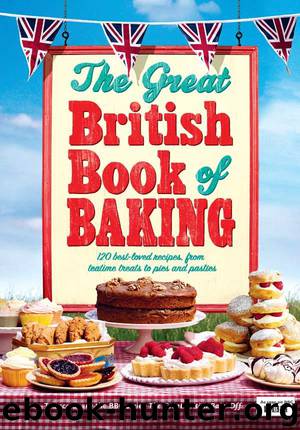
Author:Collister, Linda [Collister, Linda]
Language: eng
Format: mobi, epub
Publisher: Penguin UK
Published: 2010-09-08T16:00:00+00:00
How to Make Hot Water Crust Pastry: This is a crisp, firm, robust pastry made and filled in the same way as the medieval pie crust called a coffin or coffer. From the fourteenth century, and perhaps earlier, cooks made tough flour and water pastes to wrap joints of meat to keep them moist during cooking. This paste ‘coffin’, called a ciste in Wales, was chipped off after baking and discarded. Later, fat and spices were added to make the pastry edible.
Hot water crust is quite distinct from our other methods of pastry-making; here the fat, lard or white fat, is melted with water (and often some milk), then mixed while still hot into flour and salt to make a smooth and pliable paste that can be rolled out or moulded or worked, ‘raised’, by hand, rather like clay, to line or cover a mould. The pastry is strong enough to hold a compact meaty filling and absorb all the meat juices during baking. After baking and cooling, the filling usually contracts and the pastry case can be filled with cold stock to fill up the gaps left. It is usually eaten cold.
To make the pastry, sieve the flour, usually a good strong white flour (not the extra strong Canadian kind) or good-quality plain flour (not the very soft kind used just for cakes and sauces) and salt into a heatproof bowl. Put the fat and water (or milk and water) into a pan and heat gently until the fat melts, without letting the mixture boil. Pour into the centre of the flour and mix vigorously with a wooden spoon to make a soft, paste-like dough. Don’t worry if it looks a mess to begin with, it will come together as you beat. When the mixture is cool enough to handle, cut off a piece for the lid and reserve. The large piece can be rolled out or moulded by hand to form a case for the filling. It’s important there are no cracks or holes. The trimmings can be used to make decorations: leaves – oak leaves are traditional for pork fillings – tassels, flowers or rosettes, even plaited or twisted ropes.
Download
The Great British Book of Baking: 120 best-loved recipes from teatime treats to pies and pasties. To accompany BBC2's The Great British Bake-off by Collister Linda.epub
This site does not store any files on its server. We only index and link to content provided by other sites. Please contact the content providers to delete copyright contents if any and email us, we'll remove relevant links or contents immediately.
Whiskies (Collins Gem) by dominic roskrow(45250)
101 Whiskies to Try Before You Die by Ian Buxton(45008)
World's Best Whiskies by Dominic Roskrow(44913)
Whiskies Galore by Ian Buxton(41993)
The Fast Metabolism Diet Cookbook by Haylie Pomroy(21131)
Chic & Unique Celebration Cakes by Zoe Clark(20057)
Craft Beer for the Homebrewer by Michael Agnew(18237)
The Bone Broth Miracle: How an Ancient Remedy Can Improve Health, Fight Aging, and Boost Beauty by Ariane Resnick(16596)
For the Love of Europe by Rick Steves(13905)
Tools of Titans by Timothy Ferriss(8365)
A Court of Wings and Ruin by Sarah J. Maas(7819)
How to Be a Bawse: A Guide to Conquering Life by Lilly Singh(7471)
Chowders and Soups by Liz Feltham(7450)
The Institute by Stephen King(7023)
Cravings: Recipes for All the Food You Want to Eat by Chrissy Teigen & Adeena Sussman(6777)
Wiseguy by Nicholas Pileggi(5769)
The Last Wish (The Witcher Book 1) by Andrzej Sapkowski(5457)
Spare by Prince Harry The Duke of Sussex(5176)
Room 212 by Kate Stewart(5105)
